The treatment phase is where PI cases quietly lose value
PI case managers lose hours chasing clients through treatment, and the gaps show up later in case value. See how Hona's AI Care Coordinator keeps clients in care.
The Hona Blog
Explore the Latest Trends, Tips, and Strategies in Legal Tech and Client Communication


PI case managers lose hours chasing clients through treatment, and the gaps show up later in case value. See how Hona's AI Care Coordinator keeps clients in care.
Ask a personal injury case manager where their day goes and you will hear the same answer. Chasing clients through treatment. Confirming appointments. Following up on the ones who went quiet. It is some of the most important work in the case, and it is also some of the most repetitive.
That repetition carries a cost that does not show up until much later. When a client misses appointments or drifts out of treatment, the gap lands in the demand months down the road, when it is too late to fix. Gaps in care become gaps in case value. Most firms already know this. The hard part is staying on top of it across a full caseload without burning out the people doing the follow-up.
Rooney Agramonte, a case manager at Voto & Cavalli, described the before state plainly:
"Following up with clients was one of the most time-consuming things we did. The AI Care Coordinator is easing the pain. I think it's something we want to keep."
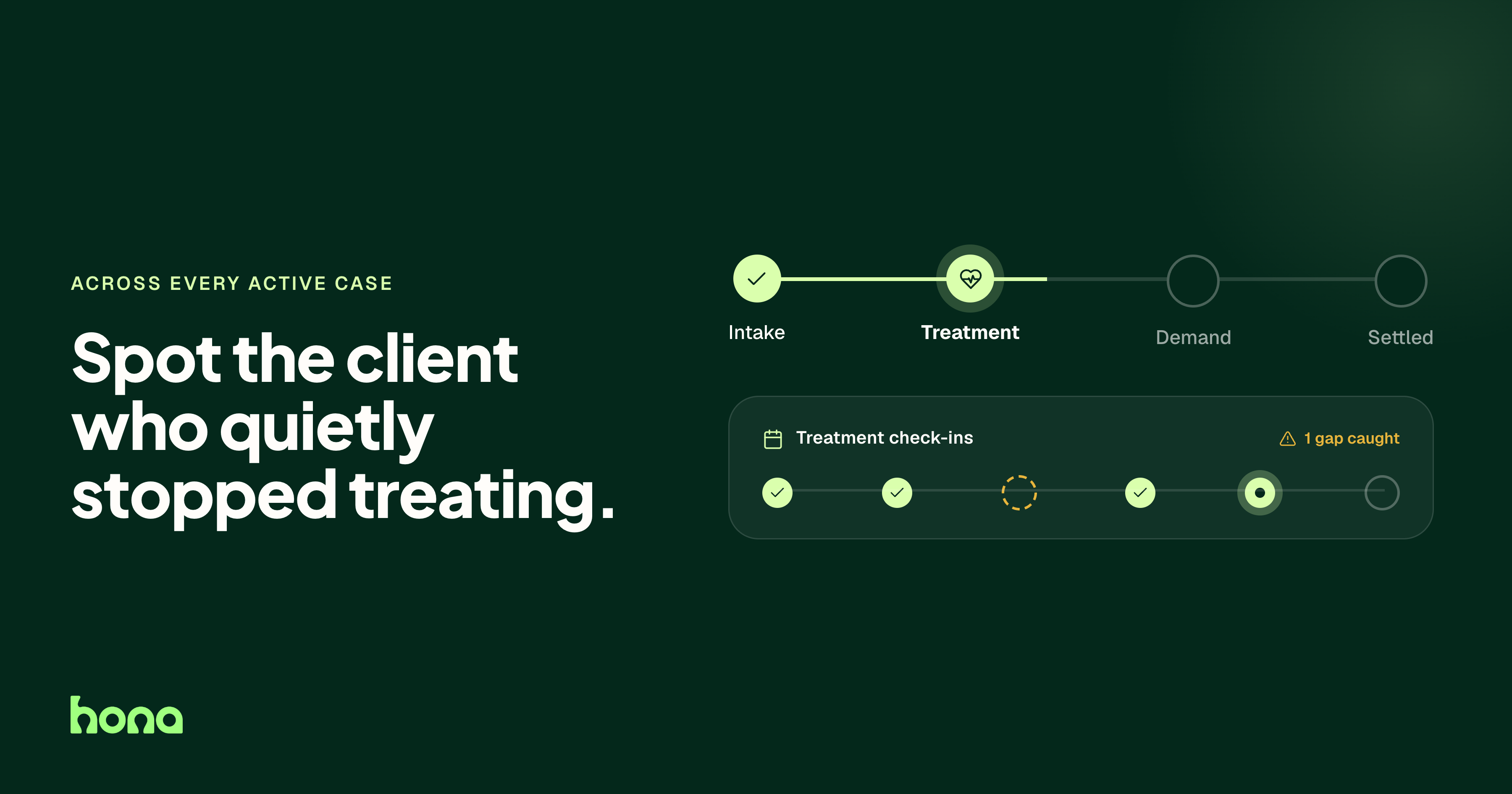
The treatment phase is long, and it moves at the client's pace, not the firm's. A single client might see a chiropractor, a pain management specialist, and an orthopedist over several months. Every visit matters to the case. Every missed visit is a small hole in the eventual demand.
The work is hard to keep up with for a few reasons:
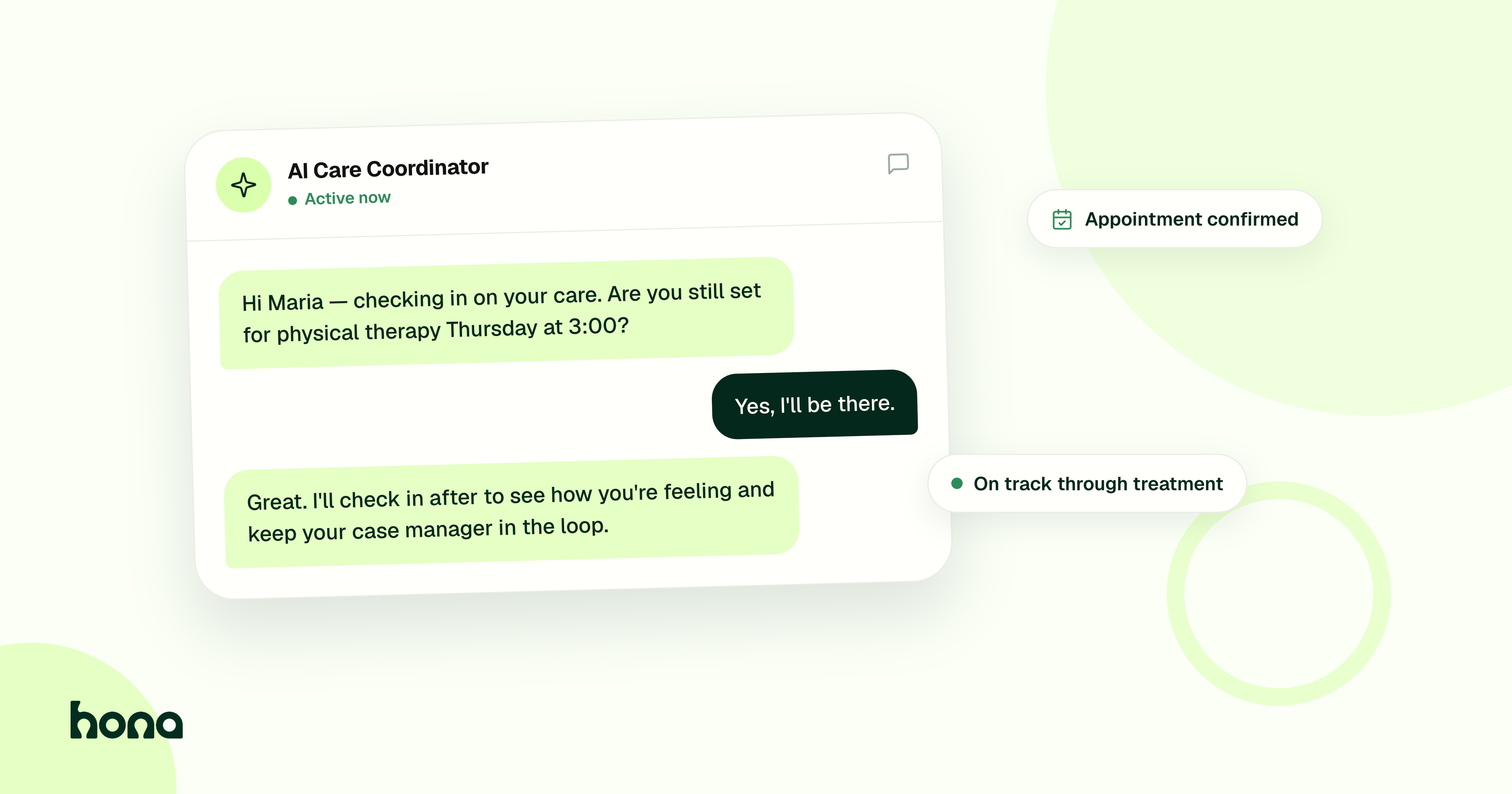
Hona's AI Care Coordinator handles the medical touchpoints a case manager would otherwise chase by hand. It works through text, the way clients already prefer to communicate, and it runs in the background across every active case.
The piece that sets it apart is that it is interactive. One-way reminder automations fall over the moment a client replies with a real question or a change in their situation, and a client who is actively treating will do exactly that. The AI Care Coordinator responds, follows up after appointments, and notices when a new provider enters the picture.
Higher appointment attendance and fewer treatment gaps mean a cleaner, more complete picture by the time the case reaches demand. The details that drive value get captured while the case is active, instead of being reconstructed after the fact. Your firm shifts from reactive, finding out about a problem after it happened, to proactive, catching it while there is still time to act.
The human side does not get lost either. The coordinator takes the repetitive work off your case managers so they can spend their attention on the clients who need a real conversation, not another reminder text.
The treatment phase is where personal injury cases quietly gain or lose value. Giving it consistent attention used to mean hiring more people or accepting that some follow-up would slip. That tradeoff is no longer the only option.
Want to see what the treatment phase looks like when the follow-up runs itself? Book a demo.
Don’t miss out on valuable content that can revolutionize your law firm.

Filevine includes a free portal, but free has a cost when clients don't use it. Compare adoption and staff time, and what Hona adds on top of Filevine.
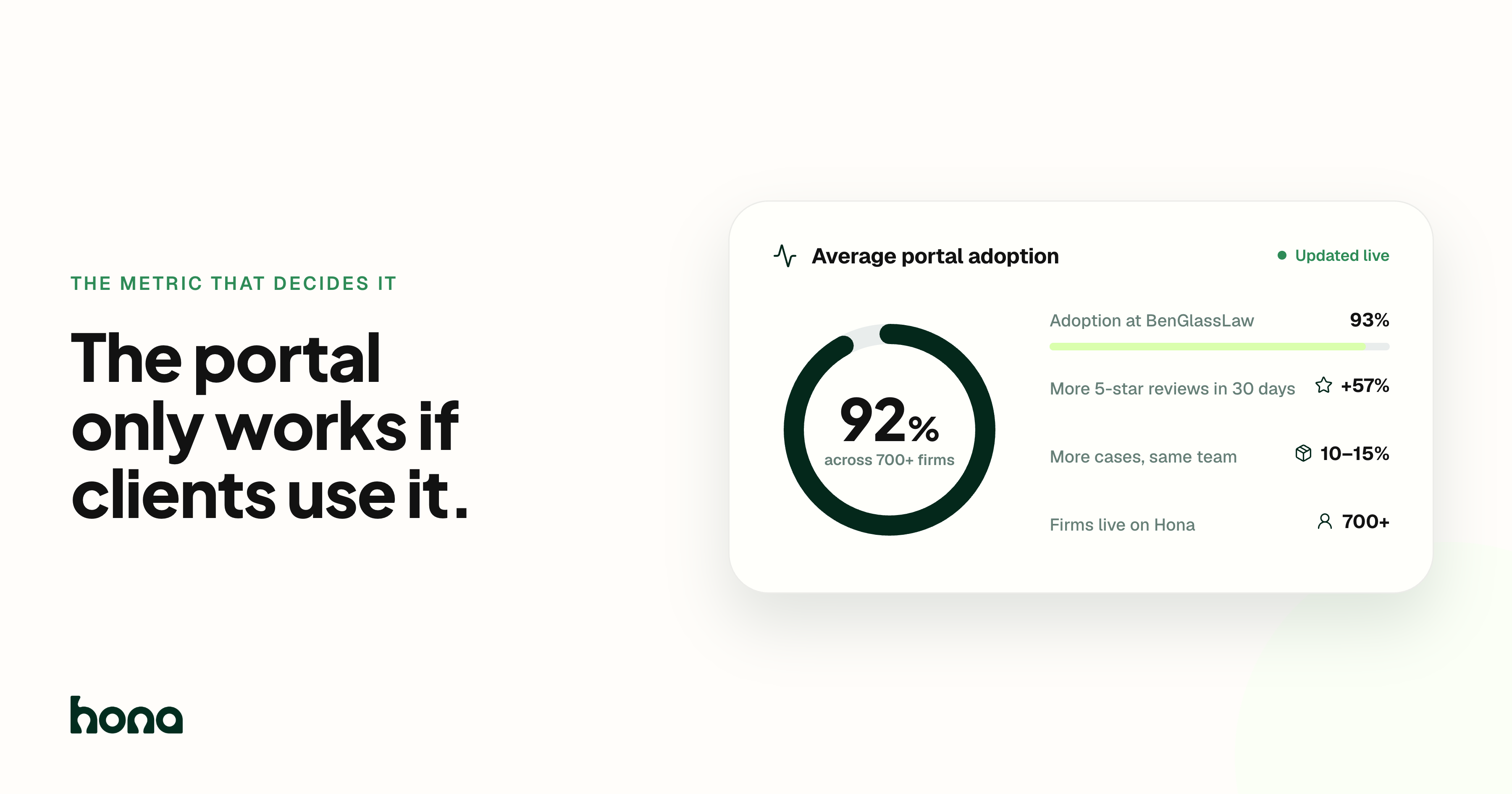
If your firm runs on Filevine, you already have a client portal included. So why pay for another one? It is a fair question, and the honest answer comes down to one metric: how many of your clients actually use what you have.
A portal that ships free with your case management system is convenient for procurement. But “free” has a cost that never shows up on the invoice. It shows up in adoption, in staff hours, and in the status calls that keep coming.
Every personal injury firm wants the same thing from a portal: fewer “where is my case” calls and clients who feel looked after. A portal only delivers that if clients open it. When adoption is low, the costs pile up quietly.
Free is a great price for a portal that gets used. It is an expensive distraction for one that does not.
This is not a rip-and-replace decision. Hona integrates with Filevine, so your case data stays where it lives and Hona becomes the client-facing layer on top. Your team keeps working in FileVine. Your clients get a communication experience built for them.
The difference between a bundled portal and a dedicated communication platform shows up in the numbers clients drive.
“WE LOVE HONA! The phase change texts, portal descriptions, and texting has cut down our call volume SO MUCH.” Julia Fuller, Adam Smallow Injury Lawyers
If the Filevine portal is getting strong adoption at your firm and the calls have dropped, keep it. You do not need another tool. But if clients are not logging in and your team is still fielding status calls, the free portal is costing you more than a paid one would. Weigh it on:
Book a short demo and we will show you the link-based portal, the Filevine integration, and the adoption numbers behind it.

Treatment compliance is one of the biggest drivers of case value, yet most PI firms never measure it. See how to track it, and how the AI Care Coordinator helps.
Most personal injury firms can tell you their settlement averages, their case volume, and their marketing spend down to the dollar. Ask them what share of their clients are keeping up with treatment right now, and the room goes quiet. It is one of the most direct drivers of case value, and almost nobody measures it.
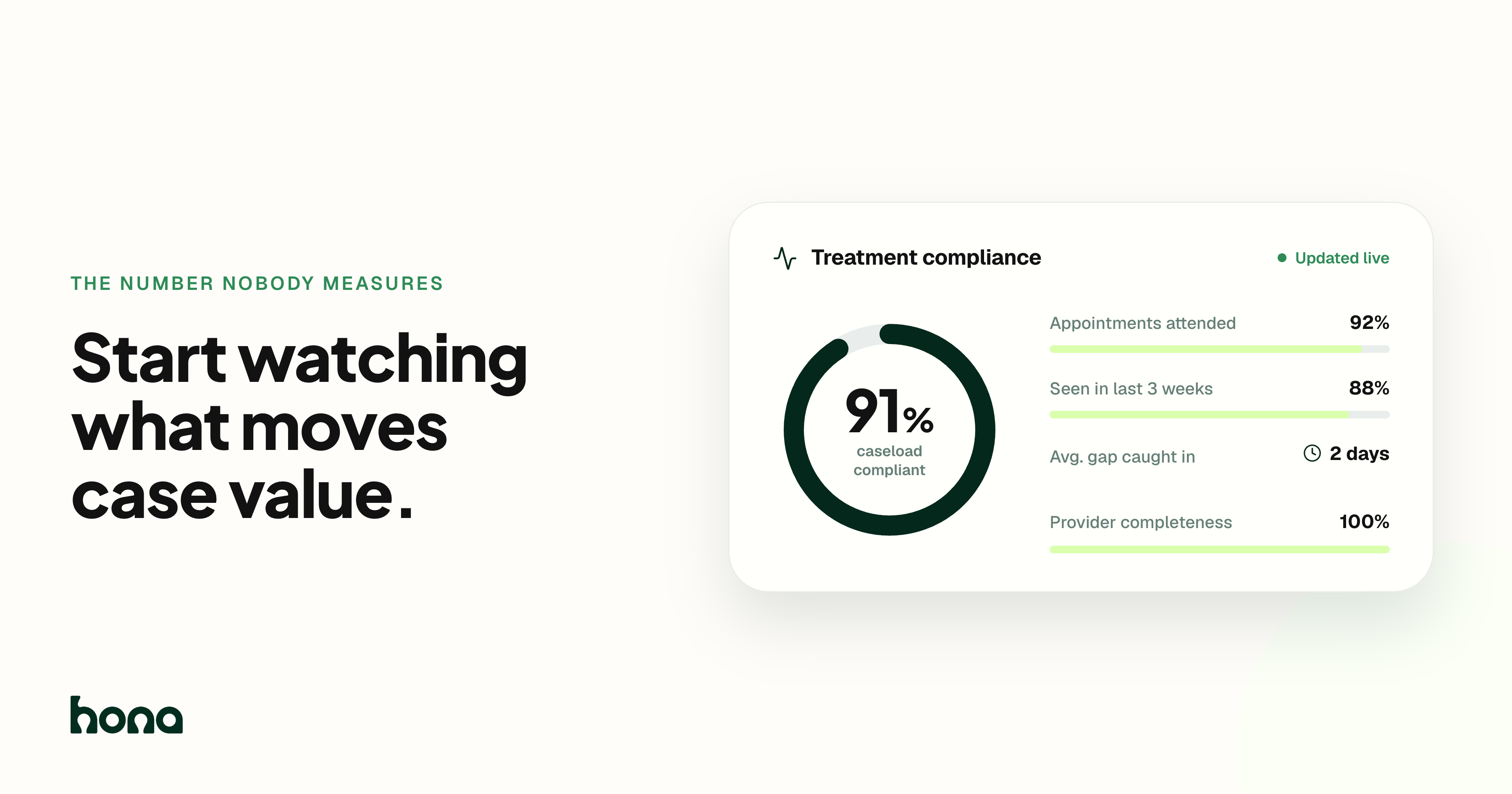
Treatment compliance is a simple idea with real teeth. It is the degree to which your clients attend the appointments their care requires and stay in treatment through the life of the case. When a client keeps up, the medical record tells a clean, consistent story. When a client drifts, gaps appear, and gaps in care become gaps in case value. Most attorneys already believe this. The catch is that believing it and measuring it are two different things.
The result is that most firms learn a client stopped treating only when someone happens to call, or worse, when the gap turns up in the demand.
You do not need a data team to start. A workable read on treatment compliance comes from a few questions you can ask about every active case:
Track those consistently and you have a live read on the health of your caseload instead of a surprise waiting in the demand.
The reason firms skip this has nothing to do with caring. Measuring it by hand means calling every client, every week, and logging the answers, and nobody has time for that across a full caseload.
This is the part Hona's AI Care Coordinator was built for. It works through the treatment phase over text, confirms appointments, catches missed ones, and tracks where each client is in care, including the providers they are seeing. Because it is interactive, it can follow up after an appointment and escalate anything that needs a human. The byproduct of all that outreach is the exact data most firms cannot collect: a current, case-by-case view of who is in treatment and who has slipped.
Rooney Agramonte, a case manager at Voto & Cavalli, put the day-to-day reality plainly:
“Following up with clients was one of the most time-consuming things we did. The AI Care Coordinator is easing the pain. I think it's something we want to keep.”
Rooney A. Agramonte, Case Manager, Voto & Cavalli, P.C.
Treatment compliance is the rare metric that touches client wellbeing and case value at the same time. A client who stays in care tends to heal better and settle stronger. You cannot improve what you never look at, so the first step is simply to start watching it.
Want to see treatment compliance measured automatically, case by case? Book a demo.

Treatment follow-up scales in the wrong direction, and more paralegals is the usual fix. See how Hona's AI Care Coordinator tracks client treatment without adding hours.
Ask a personal injury case manager where their week goes and the honest answer is follow-up. Confirming appointments. Texting the client who went quiet. Logging which provider someone saw last. It is essential work, and it scales in exactly the wrong direction. Every new case adds more of it, and the obvious fix is always more people.
Most firms keep up by adding hours: a longer task list for the case manager, or another paralegal once the caseload grows. That works until it does not, and it caps how many cases the firm can carry.
There is another way to absorb the work, and it does not mean replacing the people who do it. Hona's AI Care Coordinator handles the routine treatment touchpoints a case manager would otherwise chase by hand, over text, across every active case.
The piece that makes this work is that it is interactive. A one-way reminder blast falls apart the second a client texts back, and a client who is actively treating will text back. The AI Care Coordinator can respond, follow up after an appointment, and pick up on a new provider the client mentions.
The aim is more capacity from the same team, not a smaller one. When the appointment reminders and check-ins run on their own, your case managers can spend their time on the conversations that need a human: the empathy-driven, trust-building work that actually keeps a client in their case.
Rooney Agramonte, a case manager at Voto & Cavalli, described the shift plainly:
“Following up with clients was one of the most time-consuming things we did. The AI Care Coordinator is easing the pain. I think it's something we want to keep.”
Rooney A. Agramonte, Case Manager, Voto & Cavalli, P.C.
Fewer missed appointments and fewer treatment gaps mean a cleaner, more complete record by the time a case reaches demand. The firm moves from reactive, finding out about a problem after it happened, to proactive, catching it while there is still time to act. And it does that without another line on the payroll.
Want to see what treatment tracking looks like when the follow-up runs itself? Book a demo.

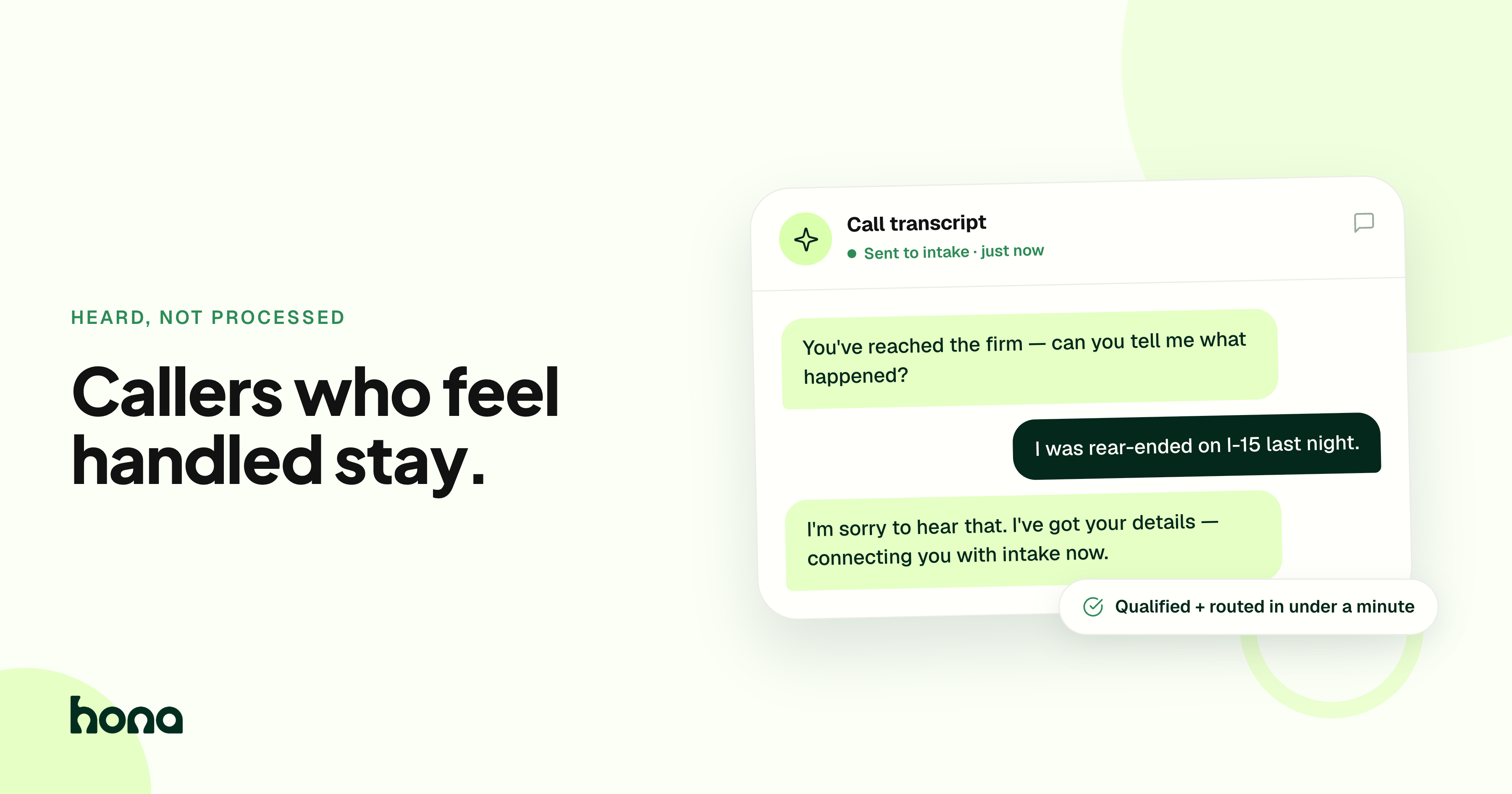
A traditional answering service takes a message. See what actually converts a caller, and how Hona's AI Receptionist answers, qualifies, and routes every call 24/7.
A strong case calls your firm at 7 p.m. on a Tuesday. Your office is closed. What happens in the next 30 seconds decides whether that caller becomes a client or dials the next firm on their list.
Most firms answer this with a traditional answering service. It feels like the safe choice. Someone picks up, takes a message, and passes it along. But taking a message and signing a client are not the same job, and the space between them is where good cases quietly disappear.
A legal answering service is built to take a message, not to qualify a case. That difference shows up fast.
None of that is the operator's fault. They are doing the job the model was built for. It just is not the job of turning a caller into a signed client.
Strip it down and a caller who signs usually got three things on that first call.
Speed and relevance win. A caller who feels handled stays. A caller who feels processed leaves.
Hona's AI Receptionist answers every call, 24/7, and treats the first 30 seconds like they matter.
It is strongest at the work most calls actually need: answering, qualifying, after-hours and overflow coverage, and routing. For firms with simple intake, it can collect the core details on the spot. For more complex matters, it captures what counts and hands off cleanly, so a strong case never spends the night in a voicemail box.
This is where firms expect AI to fall down. The worry is that callers can tell, and that it costs you the warmth a good intake depends on. WIN Disability, a disability firm, had the same worry before they tried it.
“I rolled my eyes at first. Now? My answer is an unequivocal YES.”
“She [Hona's AI receptionist] didn't sound robotic, she sounded real.”
Sam Dygert, Chief Operations Officer, WIN Disability
Hona's AI Receptionist is priced per call, not per minute. A busy month does not turn into a surprise bill, and no one on your side is quietly rewarded for rushing a caller off the phone.
The caller you never spoke to is the case you never signed. See what changes when every call gets answered, qualified, and routed the same way, every time. Book a demo.

Clients call for status updates because they are anxious, not because anything changed. See how Hona's client portal cuts those calls with updates clients use.
Every firm knows the call. A client checks in, not because anything changed, but because they have not heard anything and they are anxious. One call is nothing. Multiply it across a full caseload, every week, and your team loses hours to updates that could have answered themselves.
It helps to name what is actually happening on those calls. The client is not difficult. They are uncertain. They do not know what stage their case is in, what happens next, or whether anyone is still working on it. When the only way to get reassurance is to call the office, they call the office.
Repetitive status calls do more damage than the minutes they take:
This is the idea behind Hona's client portal. Clients track their case the way they track a package, with plain-language updates at each phase, so they always know what is happening and what comes next. The status calls drop because the answer is already in their hand, available any time of day without anyone at the firm lifting a finger.
Mark Nicholson of the Law Office of Mark Nicholson saw the change once his clients could follow along on their own:
"It has drastically reduced people calling, trying to find out what's going on in their case."
This is not a small effect. Across the firms using Hona:
The time your team gets back goes straight into the work that needs a human: the complex questions, the hard conversations, and the cases themselves.
Clients call because they are unsure. Remove the uncertainty and the calls take care of themselves. When clients can see their case clearly and get updates as it moves, they stop needing to ask.
Give your clients the updates and give your team their day back. Book a demo.

A big share of new client calls come in after hours and go unanswered. See how Hona's AI Receptionist answers, qualifies, and routes every call 24/7.
Here is an uncomfortable truth for most firms. A large share of new client calls come in when no one is at the desk to answer them. After hours. Over lunch. During the afternoon rush when every line is busy. Those callers rarely leave a voicemail and wait. They call the next firm on the list, and you never even know the lead existed.
For a personal injury or disability practice, where a single signed case can be worth a great deal, a missed call is not a small thing. It is lost revenue that never shows up in a report, because you cannot measure the clients you never spoke to.
Most firms have tried to plug the gap with a traditional answering service. The results tend to disappoint:
Callers can tell the difference too. A clumsy answering experience is sometimes worse than voicemail.
Hona's AI Receptionist answers every call, 24/7, and handles the parts of the conversation that used to require a person at the front desk.
It earns its keep on the calls that would otherwise go unanswered: after hours, during the lunch rush, or when your lines are already full. It picks up the routine questions that pull staff off higher-value work, and it makes sure a real opportunity always reaches a human.
WIN Disability put Hona's AI Receptionist in front of their inbound calls. Here is what their Chief Operations Officer, Sam Dygert, told us:
"She [Hona's AI receptionist] saved us 111 hours in 30 days. We really are saving a whole body."
"We have effectively absorbed an entire position within our Intake Department."
That is the real return. Not just fewer missed calls, but hours of staff time handed back and a full intake role's worth of capacity absorbed by a tool that never clocks out.
Hona's AI Receptionist is priced per call, not per minute. A long, complicated call costs the same as a short one, so your bill stays predictable even in a busy month. You are not penalized for the exact thing you want more of: callers who want to become clients.
You cannot sign a client you never spoke to. The leads slipping through after hours are often the easiest revenue a firm can recover, because the intent is already there. They are just calling when no one is picking up.
See what your firm stops missing. Claim your trial.