The treatment phase is where PI cases quietly lose value
PI case managers lose hours chasing clients through treatment, and the gaps show up later in case value. See how Hona's AI Care Coordinator keeps clients in care.
The Hona Blog
Explore the Latest Trends, Tips, and Strategies in Legal Tech and Client Communication


PI case managers lose hours chasing clients through treatment, and the gaps show up later in case value. See how Hona's AI Care Coordinator keeps clients in care.
Ask a personal injury case manager where their day goes and you will hear the same answer. Chasing clients through treatment. Confirming appointments. Following up on the ones who went quiet. It is some of the most important work in the case, and it is also some of the most repetitive.
That repetition carries a cost that does not show up until much later. When a client misses appointments or drifts out of treatment, the gap lands in the demand months down the road, when it is too late to fix. Gaps in care become gaps in case value. Most firms already know this. The hard part is staying on top of it across a full caseload without burning out the people doing the follow-up.
Rooney Agramonte, a case manager at Voto & Cavalli, described the before state plainly:
"Following up with clients was one of the most time-consuming things we did. The AI Care Coordinator is easing the pain. I think it's something we want to keep."
The treatment phase is long, and it moves at the client's pace, not the firm's. A single client might see a chiropractor, a pain management specialist, and an orthopedist over several months. Every visit matters to the case. Every missed visit is a small hole in the eventual demand.
The work is hard to keep up with for a few reasons:
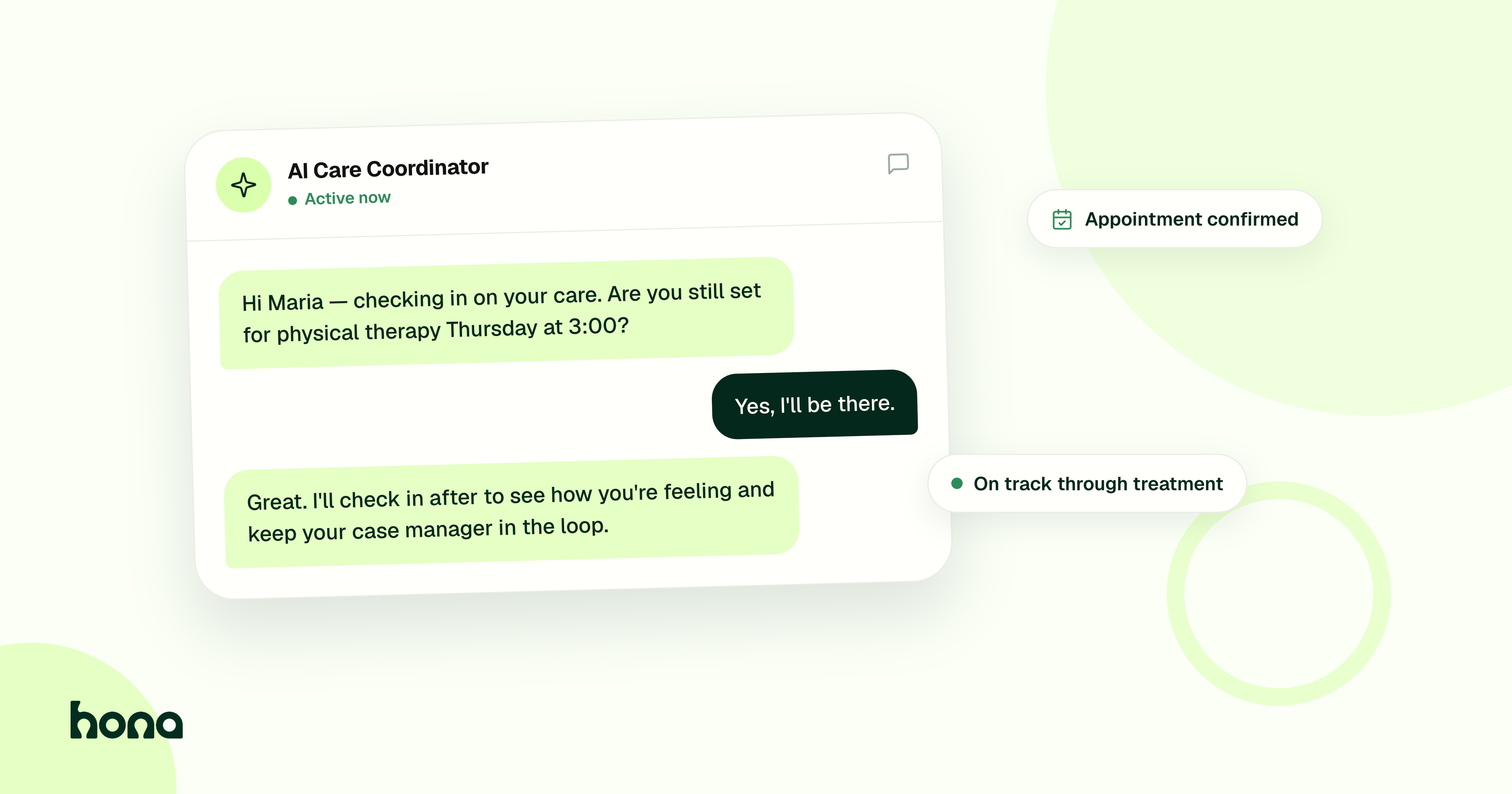
Hona's AI Care Coordinator handles the medical touchpoints a case manager would otherwise chase by hand. It works through text, the way clients already prefer to communicate, and it runs in the background across every active case.
The piece that sets it apart is that it is interactive. One-way reminder automations fall over the moment a client replies with a real question or a change in their situation, and a client who is actively treating will do exactly that. The AI Care Coordinator responds, follows up after appointments, and notices when a new provider enters the picture.
Higher appointment attendance and fewer treatment gaps mean a cleaner, more complete picture by the time the case reaches demand. The details that drive value get captured while the case is active, instead of being reconstructed after the fact. Your firm shifts from reactive, finding out about a problem after it happened, to proactive, catching it while there is still time to act.
The human side does not get lost either. The coordinator takes the repetitive work off your case managers so they can spend their attention on the clients who need a real conversation, not another reminder text.
The treatment phase is where personal injury cases quietly gain or lose value. Giving it consistent attention used to mean hiring more people or accepting that some follow-up would slip. That tradeoff is no longer the only option.
Want to see what the treatment phase looks like when the follow-up runs itself? Book a demo.
Don’t miss out on valuable content that can revolutionize your law firm.

Artificial Intelligence (AI) isn’t just for tech startups, it’s quietly (and quickly) changing the way law firms attract, engage, and convert new clients.
Artificial Intelligence (AI) isn’t just for tech startups, it’s quietly (and quickly) changing the way law firms attract, engage, and convert new clients. Here’s how smart firms are putting AI to work on the front lines of client acquisition:
Law firms already using AI in their client acquisition strategies are seeing the impact:
It’s not just more efficient, it’s how modern firms will grow smarter, stay competitive, and show up better for clients.

Ultimately, the best platform is the one that supports how your firm works. Consider your size, case volume, workflow preferences, and growth plans.
Choosing the right case management system isn’t just a tech decision, it’s a strategic one. The right platform helps your firm run more efficiently, scale with confidence, and deliver a better client experience.
Clio, Filevine, and MyCase are three of the most popular tools in the legal world, each with its own strengths (and tradeoffs). Here’s a straight-to-the-point comparison to help you choose the one that fits your firm best.
Clio is the heavyweight in the space, for good reason. It's built for flexibility, integrations, and growth.
Strengths:
Weaknesses:
Best fit for: Firms looking for a comprehensive system that can grow and evolve with them.
Filevine is purpose-built for teams, especially those working in litigation-heavy environments.
Strengths:
Weaknesses:
Best fit: Firms with high case volumes that need tailored workflows and team visibility.
MyCase is a great entry point for firms that want functionality without complexity.
Strengths:
Weaknesses:
Best fit: Solo and small firms prioritizing ease of use and client communication on a budget.
Choosing a case management platform is a smart move. Adding Hona? That’s the power play. It plugs into any system, Clio, Filevine, MyCase, and instantly upgrades how you communicate with clients. Hona complements any case management platform by providing seamless client updates, secure messaging, and automation.
Ultimately, the best platform is the one that supports how your firm works. Consider your size, case volume, workflow preferences, and growth plans. Then choose the solution that aligns with your goals, and supercharge it with tools like Hona to ensure nothing slips through the cracks.

Building a strong reputation doesn’t happen overnight, but it does happen consistently.
Positive reviews and client referrals are among the most powerful tools in your law firm’s growth strategy. Why? Because people trust people. In fact, 82% of legal clients read online reviews before ever reaching out to an attorney, according to a FindLaw survey. Reviews build credibility, boost trust, and bring in more business than any cold ad ever could. If you want to turn satisfied clients into your firm’s loudest cheerleaders, here are actionable strategies to make it happen.
SEO Tip: Include keywords like “how to leave a Google review for a law firm” in anchor text or FAQs.
Pro Tip: Personalized messages perform significantly better than generic ones in client feedback campaigns.
Building a strong reputation doesn’t happen overnight, but it does happen consistently. And in today’s digital-first world, online reviews are often the first impression your firm makes. When you make it easy for clients to share their experiences, and you’re intentional about when and how you ask, you turn everyday moments into long-term impact.
By weaving these strategies into your client experience, your firm will consistently generate positive reviews, encourage referrals, and build a strong, authentic reputation in the legal community.

The legal industry isn’t exactly known for moving fast, but client expectations sure are.
The legal industry isn’t exactly known for moving fast, but client expectations sure are. As we continue into a more digitized world, people are no longer satisfied with traditional, one-way communication. They’re used to tracking packages, getting banking alerts, and managing their lives from their phones.
And guess what? Legal clients are no exception.
According to the latest Clio Legal Trends Report, 60% of clients now say they prefer to get their case updates through secure online portals. Marking a significant shift away from traditional phone calls and email exchanges.
Modern clients aren’t comparing you to other firms. They’re comparing you to every digital experience in their lives. And if you don’t measure up, they’ll find someone who does.
Clear, reliable communication. It’s one of the first things clients judge you on, and one of the biggest factors in whether they stick around. Firms that embrace secure, digital-first tools aren’t just checking a box, they’re showing up in a way that builds trust and sets them apart.
The legal world is shifting fast. Hanging on to old habits (like relying on calls or scattered emails) will only slow your team and firm down.

Let’s be real: running a law firm today isn’t just about winning cases, it’s about keeping everything behind the scenes from falling apart.
Let’s be real: running a law firm today isn’t just about winning cases, it’s about keeping everything behind the scenes from falling apart. If your tools aren’t talking to each other, your team’s losing hours (and probably patience) on tasks that should’ve been automated yesterday.
The fix? Integrations. They’re how you turn your software from a cluttered dashboard into a well-oiled machine.
Integrations are how your case management system—Clio, Filevine, MyCase, or whatever you’re using—connects with the rest of your tech stack to create streamlined, automated workflows.
No more manual entry. No more duplicating tasks or juggling multiple tabs to get simple things done. With the right integrations in place, your team can work more efficiently, with less friction and fewer distractions.
Closing Thought
Disconnected systems waste time. Period.
If you're managing business operations at a law firm, it's time to ask the tough question: Are your tools helping your team, or slowing them down?
Be intentional with your integrations. Focus on what actually improves day-to-day operations. Build a firm that runs with purpose, not one held together by disconnected tools.
The legal landscape is evolving at warp speed. Staying ahead in the legal industry means adapting to evolving technological trends.
The legal landscape is evolving at warp speed. Staying ahead in the legal industry means adapting to evolving technological trends.These five legal tech trends are making waves in 2025, and they could seriously impact where your firm’s headed.
Artificial intelligence isn’t just a buzzword anymore. According to the ABA’s 2024 Legal Technology Survey, over 35% of firms are already using AI to streamline tasks like document review, legal writing, and litigation prediction. And it’s not just large firms leading the charge. Clio’s 2025 Legal Trends Report shows that a staggering 93% of mid-sized firms and solo firms now use AI in some form, with over half deploying it widely across their operations.The payoff? Less busywork, lower overhead costs, and fewer errors. Firms that haven’t adopted AI are already playing catch-up.
Law firms increasingly prioritize exceptional client experiences through advanced digital portals and real-time communication. Clients expect seamless, transparent interactions, and those firms embracing client-centric technologies will notably improve satisfaction and retention.
A sleek client experience isn’t just a “nice to have”—it’s now a dealbreaker. Research from Clio shows that 79% of clients say the ability to work with a lawyer remotely is a key factor when choosing a firm. Secure portals, mobile-friendly communication, and transparent updates are driving client satisfaction and retention. Forward-thinking firms are doubling down on tech that makes working with them seamless and stress-free.
In 2025, disconnected tech is dead weight. Powerful APIs and seamless integrations are transforming legal tech, simplifying workflows and eliminating repetitive data entry. Firms that connect systems like case management, billing, and client communication are seeing major gains in efficiency and productivity.
Remote and hybrid work have become a permanent part of the legal landscape. The ABA’s 2022 survey found that 70% of lawyers work remotely at least part of the week, with younger attorneys placing a high value on flexibility.
The best firms are adapting by investing in secure remote access, cloud-based collaboration tools, and flexible digital infrastructure. This shift is becoming essential for attracting top talent for your Firm in 2025.
Gut instinct is no longer enough. Data analytics is now central to smart decision-making in legal operations. From forecasting case outcomes to analyzing client behavior and optimizing resources, firms using analytics are gaining a serious edge. Tools like Power BI, Tableau, and legal-specific platforms like LawLytics and CoCounsel (formerly CaseMetrics) are empowering firms to track, measure, and act with confidence.
These aren’t far-off predictions, they’re shifts that are already paying off for firms willing to adapt. Proactive adoption means your firm remains agile and future-proofed against industry disruptions.The firms dominating the next decade won’t just be great at law. They’ll be bold, data-driven, and tech-savvy.