The treatment phase is where PI cases quietly lose value
PI case managers lose hours chasing clients through treatment, and the gaps show up later in case value. See how Hona's AI Care Coordinator keeps clients in care.
The Hona Blog
Explore the Latest Trends, Tips, and Strategies in Legal Tech and Client Communication


PI case managers lose hours chasing clients through treatment, and the gaps show up later in case value. See how Hona's AI Care Coordinator keeps clients in care.
Ask a personal injury case manager where their day goes and you will hear the same answer. Chasing clients through treatment. Confirming appointments. Following up on the ones who went quiet. It is some of the most important work in the case, and it is also some of the most repetitive.
That repetition carries a cost that does not show up until much later. When a client misses appointments or drifts out of treatment, the gap lands in the demand months down the road, when it is too late to fix. Gaps in care become gaps in case value. Most firms already know this. The hard part is staying on top of it across a full caseload without burning out the people doing the follow-up.
Rooney Agramonte, a case manager at Voto & Cavalli, described the before state plainly:
"Following up with clients was one of the most time-consuming things we did. The AI Care Coordinator is easing the pain. I think it's something we want to keep."
The treatment phase is long, and it moves at the client's pace, not the firm's. A single client might see a chiropractor, a pain management specialist, and an orthopedist over several months. Every visit matters to the case. Every missed visit is a small hole in the eventual demand.
The work is hard to keep up with for a few reasons:
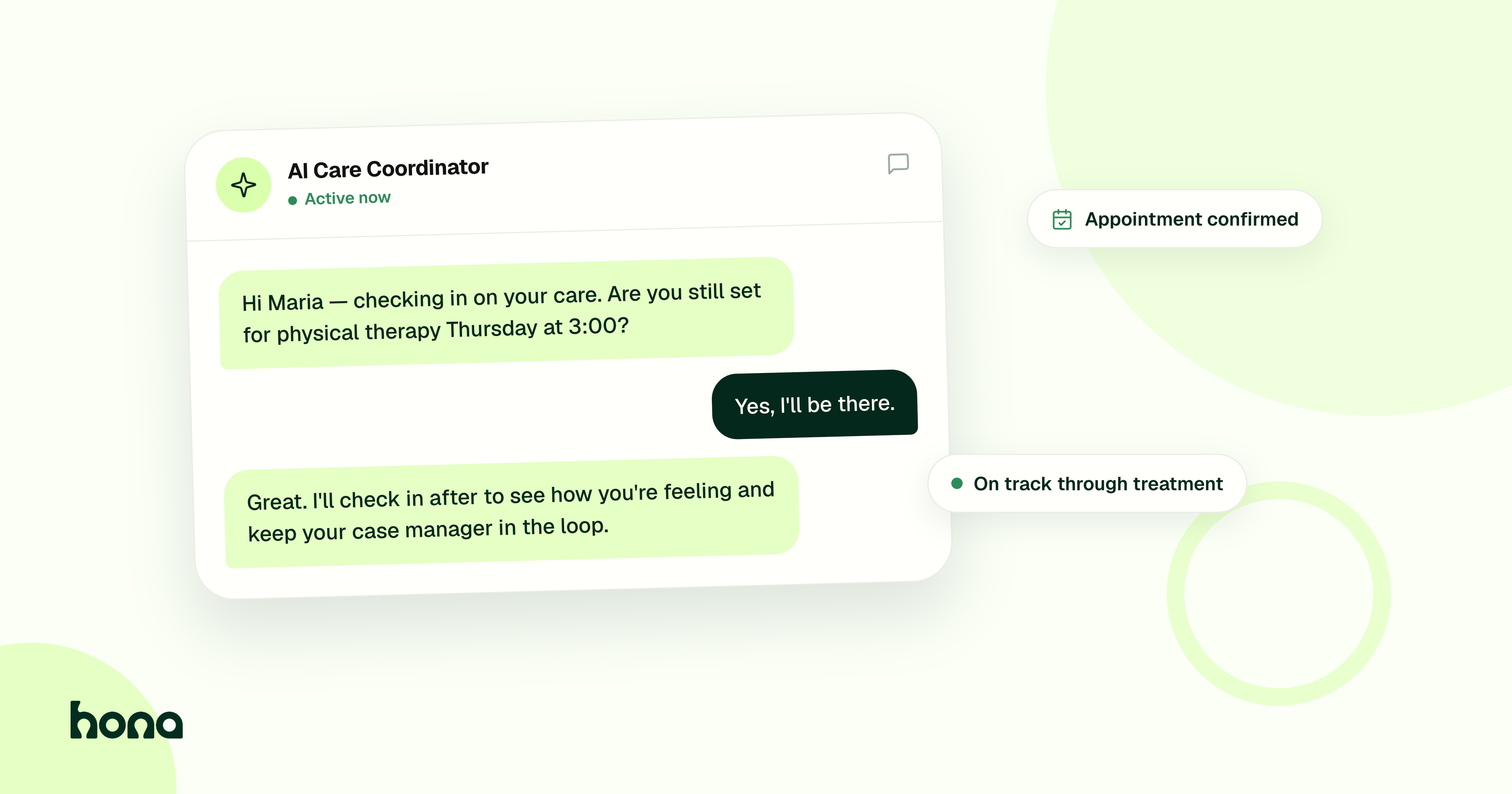
Hona's AI Care Coordinator handles the medical touchpoints a case manager would otherwise chase by hand. It works through text, the way clients already prefer to communicate, and it runs in the background across every active case.
The piece that sets it apart is that it is interactive. One-way reminder automations fall over the moment a client replies with a real question or a change in their situation, and a client who is actively treating will do exactly that. The AI Care Coordinator responds, follows up after appointments, and notices when a new provider enters the picture.
Higher appointment attendance and fewer treatment gaps mean a cleaner, more complete picture by the time the case reaches demand. The details that drive value get captured while the case is active, instead of being reconstructed after the fact. Your firm shifts from reactive, finding out about a problem after it happened, to proactive, catching it while there is still time to act.
The human side does not get lost either. The coordinator takes the repetitive work off your case managers so they can spend their attention on the clients who need a real conversation, not another reminder text.
The treatment phase is where personal injury cases quietly gain or lose value. Giving it consistent attention used to mean hiring more people or accepting that some follow-up would slip. That tradeoff is no longer the only option.
Want to see what the treatment phase looks like when the follow-up runs itself? Book a demo.
Don’t miss out on valuable content that can revolutionize your law firm.

As law firms compete more fiercely for clients online, many attorneys are contemplating whether partnering with a digital marketing agency is worth the investment.
As law firms compete more fiercely for clients online, many attorneys are contemplating whether partnering with a digital marketing agency is worth the investment. Here's what you need to know to make an informed decision.
A reputable digital marketing agency can significantly enhance your law firm's visibility and client acquisition. Services typically include:
Evaluate your firm's current capabilities, growth objectives, and internal resources. If your firm lacks dedicated marketing personnel, technical SEO knowledge, or content creation capabilities, hiring a digital marketing agency could significantly enhance your firm's competitive edge.
In conclusion, investing in a digital marketing agency can lead to substantial benefits, provided you select the right partner who understands your goals, aligns with your budget, and demonstrates clear expertise in legal marketing.

Embracing virtual legal services positions law firms strategically for future success.
The shift toward virtual legal practices has accelerated dramatically, becoming the new norm for many firms. Understanding how to successfully navigate remote services is essential for maintaining client satisfaction, efficiency, and competitiveness.
Embracing virtual legal services positions law firms strategically for future success. By leveraging technology effectively, maintaining clear communication, and ensuring robust security measures, law firms can thrive in a remote-first environment.

Every attorney encounters difficult clients. Managing these relationships effectively not only reduces stress but can also prevent misunderstandings.
Every attorney encounters difficult clients. Managing these relationships effectively not only reduces stress but can also prevent misunderstandings and improve overall client satisfaction. Here’s your guide on handling challenging client interactions.
Effectively managing difficult client interactions requires clear communication, professional boundaries, and emotional intelligence. By setting expectations early and maintaining professional communication throughout the relationship, you can significantly reduce misunderstandings and improve client relationships.

Adopting practical strategies from successful law firms can significantly enhance your practice.
Every successful attorney knows there's immense value in learning from peers who excel in the industry. This article compiles practical strategies from top-performing law firms to help attorneys enhance their practice, efficiency, and client relationships.
One key factor behind the success of leading firms like Kirkland & Ellis and Latham & Watkins is their commitment to efficiency. Both firms leverage technology to streamline routine tasks, freeing attorneys to focus on strategic work. [Link to external case study on legal tech implementation]
Effective communication strategies are another hallmark of top law firms. The Jeffcoat Firm significantly improved their Net Promoter Score (NPS) by prioritizing transparent and regular client updates through a structured client portal. [Link to Jeffcoat Firm case study]
Firms like Skadden and Sidley Austin emphasize the importance of meticulous financial planning. Implementing robust billing and financial management software has helped these firms maximize profitability and minimize administrative costs. [Link to financial management best practices]
Successful firms understand the power of branding. Cooley LLP’s emphasis on branding and thought leadership has distinguished them in the crowded legal market, helping attract both high-caliber clients and talented associates. [External link to branding case study]
Mayer Brown and Clifford Chance invest heavily in professional development, offering structured mentorship and ongoing training programs. These initiatives have proven effective in retaining talent and maintaining competitive advantage. [Link to professional development resources]
Adopting practical strategies from successful law firms can significantly enhance your practice. Whether improving efficiency, refining communication, or investing in talent development, these proven approaches provide a roadmap for sustained success in the competitive legal landscape.
.png)
Diversity, Equity, and Inclusion (DEI) initiatives are increasingly essential in the legal profession, enhancing firm culture, client relationships, and business performance.
Diversity, Equity, and Inclusion (DEI) initiatives are increasingly essential in the legal profession, enhancing firm culture, client relationships, and business performance. Here's how your law firm can effectively advance DEI practices.
Advancing DEI initiatives isn't just ethically important—it's strategically beneficial. Law firms committed to meaningful DEI strategies not only enhance their culture but also position themselves for long-term growth and success.

Small firms that adopt these strategies are seeing measurable impact: fewer hours lost to admin, smoother client experiences, and room to grow without burning out their team.
Big Law has big bucks. Giant teams. Glossy offices. But guess what? None of that matters when you’ve got tech on your side. In a world where clients care more about responsiveness and results than marble lobbies, small firms can absolutely win. If they play it smart.
Here’s how boutique and solo law warriors can leverage technology to level the playing field: (without the Big Law budget).
1. Move Case Management To The Cloud
Big firms have IT departments. You don’t need one. Cloud-based case management tools give small firms access to the kind of secure, organized infrastructure that used to be out of reach.
A secure client portal offers big-firm polish without extra admin.
Tools like video conferencing, e-signature software, and cloud storage help small firms match the flexibility and reach of larger competitors.
Gut feelings won’t cut it against Big Law’s analytic teams. Here’s how smart firms are letting data drive:
Small firms that adopt these strategies are seeing measurable impact: fewer hours lost to admin, smoother client experiences, and room to grow without burning out their team. It’s not about catching up to Big Law, it’s about building a firm that runs lean, delivers better, and stands out for all the right reasons.