blog post
Who texts your client? Ending duplicate follow-ups in PI cases

Read Time

November 25, 2026
Your firm is probably not the only one texting your client. A medical scheduling vendor confirms the MRI. The clinic sends its own reminder. A funding company checks in. Then your case manager, or your AI, asks the same question an hour later.
Each message is reasonable on its own. Together they feel like noise. The client stops reading, or starts asking which number is actually the firm.
Why duplicate outreach happens
Most firms added tools one at a time. A records vendor here, a scheduling partner there, an automated check-in on top. Every tool was set up to follow up. None of them was told what the others were doing.
The result is predictable. Two systems remind the client about the same appointment. A text repeats what a staff member said on the phone that morning. A client who goes to therapy three times a week gets a check-in after every visit.
Give every follow-up one owner
You don't need fewer tools. You need a clear answer to one question for each type of outreach: who sends this?
- Appointment reminders. If a provider or scheduling partner already confirms visits, let them own it. Your firm checks attendance after the fact.
- Treatment check-ins. Your firm owns these. Send them on a set rhythm, not after every visit.
- Records and bills. These go to providers, not clients. Keep them out of the client thread.
- Case updates. Always the firm. Nobody else should be telling a client where the case stands.
Write the list down. If two systems both claim an item, one of them needs to stop.
Make the rule something your software can see
An ownership rule only works if your automation can tell which cases it applies to. That usually means a field or tag in your case management system. A case marked as handled by an outside scheduling partner tells your automated check-ins to skip appointment reminders on that case and keep everything else.
The same goes for notes. If a case manager just spoke with the client, that call should be in the case file before the next automated message goes out. A text that repeats a phone call tells the client nobody is listening.
Set a contact budget
Decide how many messages a client in treatment should get from your firm in a normal week. One useful check-in beats four overlapping ones. Clients in heavy treatment are the ones most likely to tune out, and they are also the clients you most need to hear from.
- Consolidate. Fold several reminders into one weekly message.
- Space it out. Some firms move check-ins to every two weeks for clients who are clearly on track.
- Watch the replies. A client who answers "I already told them" is a sign two systems are asking.
Keep one thread
Whatever partners touch the case, the client should know one number as the firm. Every message from your team belongs in that one conversation and in the case file. When a partner texts the client, your staff should be able to see it, or at least know it happened.
The takeaway
More follow-up rarely means better follow-up. Decide who owns each type of outreach, mark it where your software can read it, and cap how often a client hears from your firm. Your clients will read the messages that matter, because there will be fewer of them.
In Hona, Lia, your case liaison, texts clients in the same conversation your team uses, and every message is logged on the case. Care Coordination, one of Lia's skills, can be paused for any one client from their page, and your firm can pause Engage notifications for clients Lia is already talking to, so automated drips don't double up. For more on rhythm and cadence, see the PI metric most firms never track. Book a demo to see how it works.
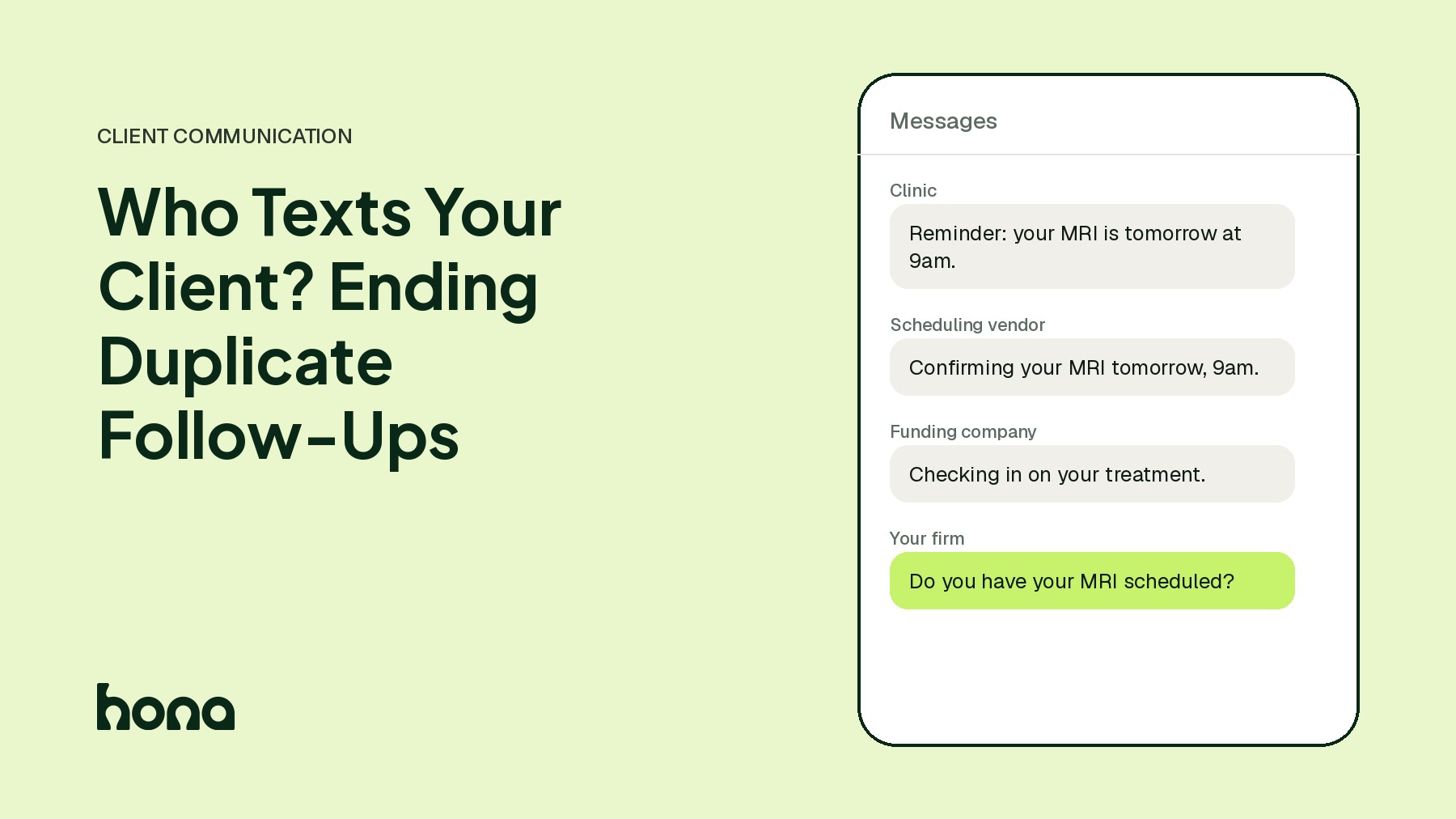
Your firm is probably not the only one texting your client. A medical scheduling vendor confirms the MRI. The clinic sends its own reminder. A funding company checks in. Then your case manager, or your AI, asks the same question an hour later.
Each message is reasonable on its own. Together they feel like noise. The client stops reading, or starts asking which number is actually the firm.
Why duplicate outreach happens
Most firms added tools one at a time. A records vendor here, a scheduling partner there, an automated check-in on top. Every tool was set up to follow up. None of them was told what the others were doing.
The result is predictable. Two systems remind the client about the same appointment. A text repeats what a staff member said on the phone that morning. A client who goes to therapy three times a week gets a check-in after every visit.
Give every follow-up one owner
You don't need fewer tools. You need a clear answer to one question for each type of outreach: who sends this?
- Appointment reminders. If a provider or scheduling partner already confirms visits, let them own it. Your firm checks attendance after the fact.
- Treatment check-ins. Your firm owns these. Send them on a set rhythm, not after every visit.
- Records and bills. These go to providers, not clients. Keep them out of the client thread.
- Case updates. Always the firm. Nobody else should be telling a client where the case stands.
Write the list down. If two systems both claim an item, one of them needs to stop.
Make the rule something your software can see
An ownership rule only works if your automation can tell which cases it applies to. That usually means a field or tag in your case management system. A case marked as handled by an outside scheduling partner tells your automated check-ins to skip appointment reminders on that case and keep everything else.
The same goes for notes. If a case manager just spoke with the client, that call should be in the case file before the next automated message goes out. A text that repeats a phone call tells the client nobody is listening.
Set a contact budget
Decide how many messages a client in treatment should get from your firm in a normal week. One useful check-in beats four overlapping ones. Clients in heavy treatment are the ones most likely to tune out, and they are also the clients you most need to hear from.
- Consolidate. Fold several reminders into one weekly message.
- Space it out. Some firms move check-ins to every two weeks for clients who are clearly on track.
- Watch the replies. A client who answers "I already told them" is a sign two systems are asking.
Keep one thread
Whatever partners touch the case, the client should know one number as the firm. Every message from your team belongs in that one conversation and in the case file. When a partner texts the client, your staff should be able to see it, or at least know it happened.
The takeaway
More follow-up rarely means better follow-up. Decide who owns each type of outreach, mark it where your software can read it, and cap how often a client hears from your firm. Your clients will read the messages that matter, because there will be fewer of them.
In Hona, Lia, your case liaison, texts clients in the same conversation your team uses, and every message is logged on the case. Care Coordination, one of Lia's skills, can be paused for any one client from their page, and your firm can pause Engage notifications for clients Lia is already talking to, so automated drips don't double up. For more on rhythm and cadence, see the PI metric most firms never track. Book a demo to see how it works.