blog post
The PI metric most firms never track: treatment compliance (and how to measure it)

Read Time

July 7, 2026
Most personal injury firms can tell you their settlement averages, their case volume, and their marketing spend down to the dollar. Ask them what share of their clients are keeping up with treatment right now, and the room goes quiet. It is one of the most direct drivers of case value, and almost nobody measures it.
What treatment compliance actually is
Treatment compliance is a simple idea with real teeth. It is the degree to which your clients attend the appointments their care requires and stay in treatment through the life of the case. When a client keeps up, the medical record tells a clean, consistent story. When a client drifts, gaps appear, and gaps in care become gaps in case value. Most attorneys already believe this. The catch is that believing it and measuring it are two different things.
Why firms do not measure it
- The data is scattered. Appointment status lives in a client's memory, a provider's calendar, and a case manager's notes, rarely in one place.
- It changes daily. Compliance is not a number you set once. It moves every time a client attends or misses a visit.
- There is no standard. Firms track intake and settlement numbers because the industry agreed those matter. Treatment compliance never got the same status, so it goes unwatched.
The result is that most firms learn a client stopped treating only when someone happens to call, or worse, when the gap turns up in the demand.
How to measure it
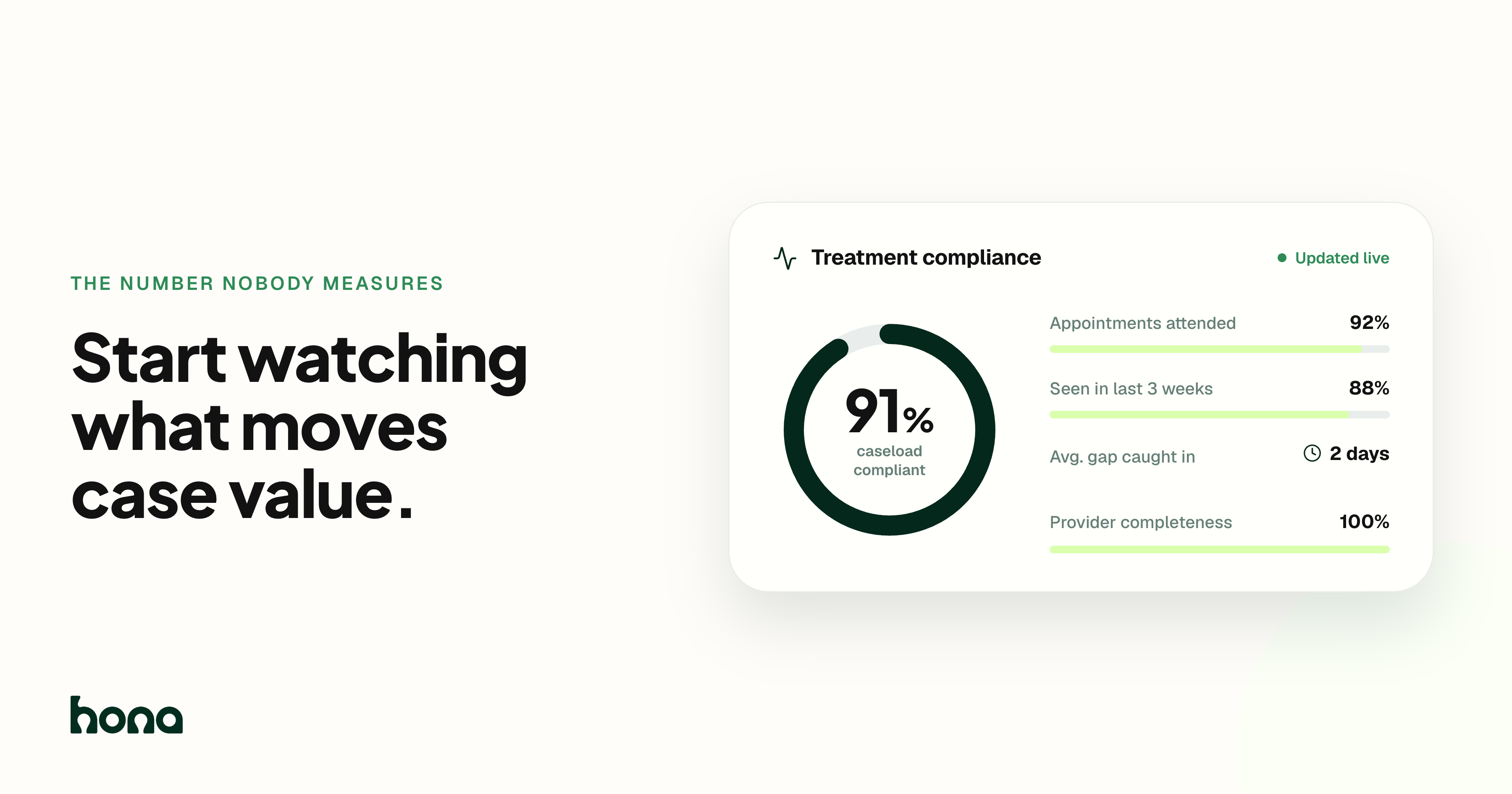
You do not need a data team to start. A workable read on treatment compliance comes from a few questions you can ask about every active case:
- Attendance. Of the appointments scheduled this period, how many did the client actually attend?
- Active treatment. How many of your treating clients have been seen by a provider in the last two to three weeks?
- Gap detection speed. When a client goes quiet, how long does it take your team to notice?
- Provider completeness. Do you have every provider a client has seen, including the ones you did not refer them to?
Track those consistently and you have a live read on the health of your caseload instead of a surprise waiting in the demand.
Where the measurement comes from
The reason firms skip this has nothing to do with caring. Measuring it by hand means calling every client, every week, and logging the answers, and nobody has time for that across a full caseload.
This is the part Hona's AI Care Coordinator was built for. It works through the treatment phase over text, confirms appointments, catches missed ones, and tracks where each client is in care, including the providers they are seeing. Because it is interactive, it can follow up after an appointment and escalate anything that needs a human. The byproduct of all that outreach is the exact data most firms cannot collect: a current, case-by-case view of who is in treatment and who has slipped.
Rooney Agramonte, a case manager at Voto & Cavalli, put the day-to-day reality plainly:
“Following up with clients was one of the most time-consuming things we did. The AI Care Coordinator is easing the pain. I think it's something we want to keep.”
Rooney A. Agramonte, Case Manager, Voto & Cavalli, P.C.
Start watching the number that moves case value
Treatment compliance is the rare metric that touches client wellbeing and case value at the same time. A client who stays in care tends to heal better and settle stronger. You cannot improve what you never look at, so the first step is simply to start watching it.
The takeaway
Want to see treatment compliance measured automatically, case by case? Book a demo.
Most personal injury firms can tell you their settlement averages, their case volume, and their marketing spend down to the dollar. Ask them what share of their clients are keeping up with treatment right now, and the room goes quiet. It is one of the most direct drivers of case value, and almost nobody measures it.
What treatment compliance actually is
Treatment compliance is a simple idea with real teeth. It is the degree to which your clients attend the appointments their care requires and stay in treatment through the life of the case. When a client keeps up, the medical record tells a clean, consistent story. When a client drifts, gaps appear, and gaps in care become gaps in case value. Most attorneys already believe this. The catch is that believing it and measuring it are two different things.
Why firms do not measure it
- The data is scattered. Appointment status lives in a client's memory, a provider's calendar, and a case manager's notes, rarely in one place.
- It changes daily. Compliance is not a number you set once. It moves every time a client attends or misses a visit.
- There is no standard. Firms track intake and settlement numbers because the industry agreed those matter. Treatment compliance never got the same status, so it goes unwatched.
The result is that most firms learn a client stopped treating only when someone happens to call, or worse, when the gap turns up in the demand.
How to measure it
You do not need a data team to start. A workable read on treatment compliance comes from a few questions you can ask about every active case:
- Attendance. Of the appointments scheduled this period, how many did the client actually attend?
- Active treatment. How many of your treating clients have been seen by a provider in the last two to three weeks?
- Gap detection speed. When a client goes quiet, how long does it take your team to notice?
- Provider completeness. Do you have every provider a client has seen, including the ones you did not refer them to?
Track those consistently and you have a live read on the health of your caseload instead of a surprise waiting in the demand.
Where the measurement comes from
The reason firms skip this has nothing to do with caring. Measuring it by hand means calling every client, every week, and logging the answers, and nobody has time for that across a full caseload.
This is the part Hona's AI Care Coordinator was built for. It works through the treatment phase over text, confirms appointments, catches missed ones, and tracks where each client is in care, including the providers they are seeing. Because it is interactive, it can follow up after an appointment and escalate anything that needs a human. The byproduct of all that outreach is the exact data most firms cannot collect: a current, case-by-case view of who is in treatment and who has slipped.
Rooney Agramonte, a case manager at Voto & Cavalli, put the day-to-day reality plainly:
“Following up with clients was one of the most time-consuming things we did. The AI Care Coordinator is easing the pain. I think it's something we want to keep.”
Rooney A. Agramonte, Case Manager, Voto & Cavalli, P.C.
Start watching the number that moves case value
Treatment compliance is the rare metric that touches client wellbeing and case value at the same time. A client who stays in care tends to heal better and settle stronger. You cannot improve what you never look at, so the first step is simply to start watching it.
The takeaway
Want to see treatment compliance measured automatically, case by case? Book a demo.
.webp)
Discover Hona's Impact
Join the proactive communication revolution. Witness how Hona’s innovative approach significantly enhances customer experience, client communication, and case management integration in the legal sector.
Request a Demo