blog post
How to track client treatment without adding paralegal hours

Read Time

July 7, 2026
Ask a personal injury case manager where their week goes and the honest answer is follow-up. Confirming appointments. Texting the client who went quiet. Logging which provider someone saw last. It is essential work, and it scales in exactly the wrong direction. Every new case adds more of it, and the obvious fix is always more people.
Why treatment tracking eats so many hours
- It never stops. While a client is treating, the reminders, confirmations, and check-ins keep coming.
- It is spread across every active case. A full caseload means dozens of clients at different points in care, each needing a nudge at a different time.
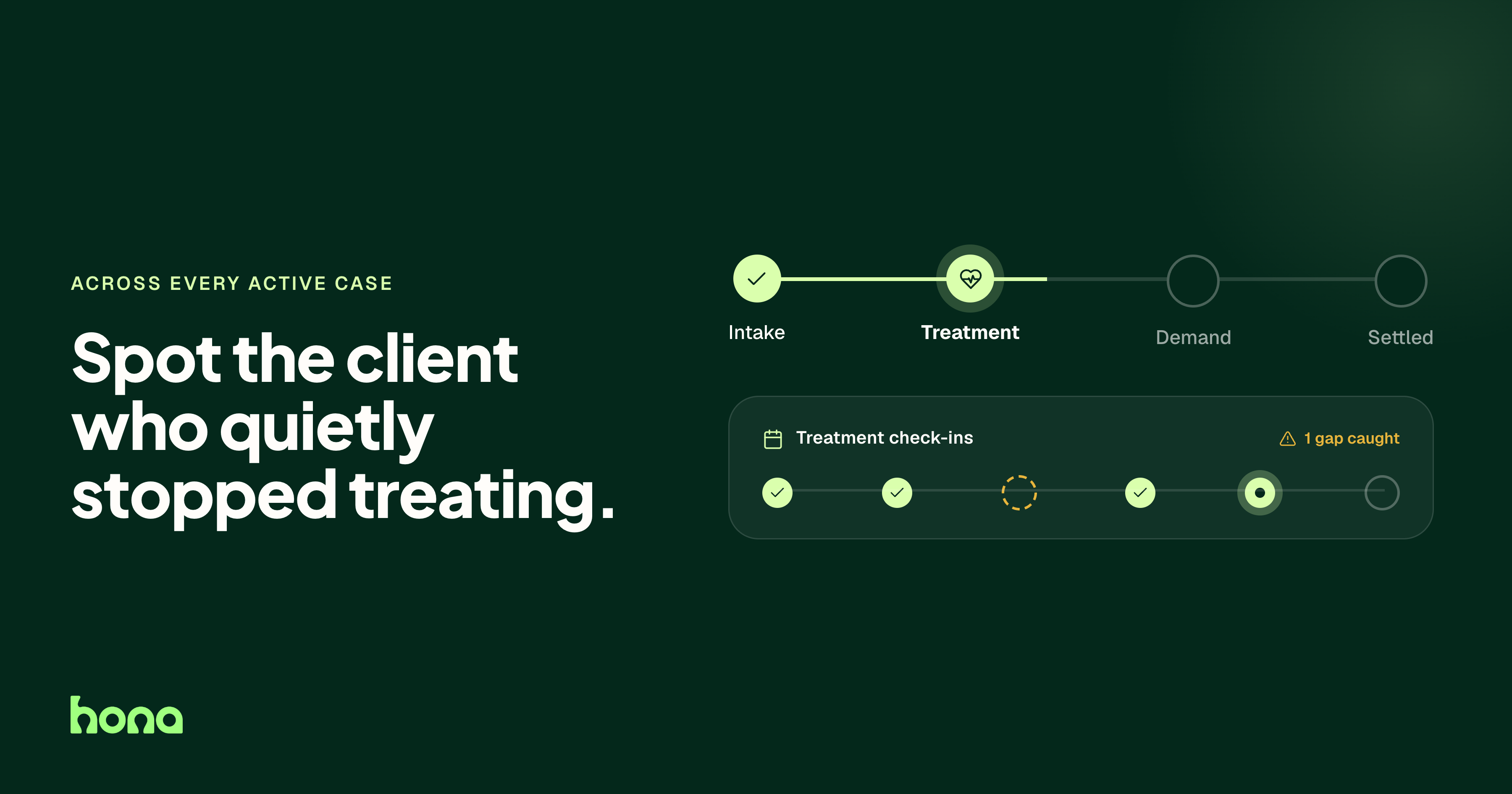
- It hides until it hurts. A client who quietly stopped treating six weeks ago is a problem you discover at the worst possible moment, when the demand is being built.
Most firms keep up by adding hours: a longer task list for the case manager, or another paralegal once the caseload grows. That works until it does not, and it caps how many cases the firm can carry.
Track treatment without growing the team
There is another way to absorb the work, and it does not mean replacing the people who do it. Hona's AI Care Coordinator handles the routine treatment touchpoints a case manager would otherwise chase by hand, over text, across every active case.
- Checks in with clients through the treatment phase and keeps them moving.
- Confirms upcoming appointments and catches the ones that get missed.
- Tracks where each client is in care, including the providers they are seeing, so the picture stays current instead of being reconstructed later.
- Escalates to your team the moment something needs a human.
The piece that makes this work is that it is interactive. A one-way reminder blast falls apart the second a client texts back, and a client who is actively treating will text back. The AI Care Coordinator can respond, follow up after an appointment, and pick up on a new provider the client mentions.
Free your team for the work only people can do
The aim is more capacity from the same team, not a smaller one. When the appointment reminders and check-ins run on their own, your case managers can spend their time on the conversations that need a human: the empathy-driven, trust-building work that actually keeps a client in their case.
Rooney Agramonte, a case manager at Voto & Cavalli, described the shift plainly:
“Following up with clients was one of the most time-consuming things we did. The AI Care Coordinator is easing the pain. I think it's something we want to keep.”
Rooney A. Agramonte, Case Manager, Voto & Cavalli, P.C.
Why this protects more than time
Fewer missed appointments and fewer treatment gaps mean a cleaner, more complete record by the time a case reaches demand. The firm moves from reactive, finding out about a problem after it happened, to proactive, catching it while there is still time to act. And it does that without another line on the payroll.
The takeaway
Want to see what treatment tracking looks like when the follow-up runs itself? Book a demo.
Ask a personal injury case manager where their week goes and the honest answer is follow-up. Confirming appointments. Texting the client who went quiet. Logging which provider someone saw last. It is essential work, and it scales in exactly the wrong direction. Every new case adds more of it, and the obvious fix is always more people.
Why treatment tracking eats so many hours
- It never stops. While a client is treating, the reminders, confirmations, and check-ins keep coming.
- It is spread across every active case. A full caseload means dozens of clients at different points in care, each needing a nudge at a different time.
- It hides until it hurts. A client who quietly stopped treating six weeks ago is a problem you discover at the worst possible moment, when the demand is being built.
Most firms keep up by adding hours: a longer task list for the case manager, or another paralegal once the caseload grows. That works until it does not, and it caps how many cases the firm can carry.
Track treatment without growing the team
There is another way to absorb the work, and it does not mean replacing the people who do it. Hona's AI Care Coordinator handles the routine treatment touchpoints a case manager would otherwise chase by hand, over text, across every active case.
- Checks in with clients through the treatment phase and keeps them moving.
- Confirms upcoming appointments and catches the ones that get missed.
- Tracks where each client is in care, including the providers they are seeing, so the picture stays current instead of being reconstructed later.
- Escalates to your team the moment something needs a human.
The piece that makes this work is that it is interactive. A one-way reminder blast falls apart the second a client texts back, and a client who is actively treating will text back. The AI Care Coordinator can respond, follow up after an appointment, and pick up on a new provider the client mentions.
Free your team for the work only people can do
The aim is more capacity from the same team, not a smaller one. When the appointment reminders and check-ins run on their own, your case managers can spend their time on the conversations that need a human: the empathy-driven, trust-building work that actually keeps a client in their case.
Rooney Agramonte, a case manager at Voto & Cavalli, described the shift plainly:
“Following up with clients was one of the most time-consuming things we did. The AI Care Coordinator is easing the pain. I think it's something we want to keep.”
Rooney A. Agramonte, Case Manager, Voto & Cavalli, P.C.
Why this protects more than time
Fewer missed appointments and fewer treatment gaps mean a cleaner, more complete record by the time a case reaches demand. The firm moves from reactive, finding out about a problem after it happened, to proactive, catching it while there is still time to act. And it does that without another line on the payroll.
The takeaway
Want to see what treatment tracking looks like when the follow-up runs itself? Book a demo.
.webp)
Discover Hona's Impact
Join the proactive communication revolution. Witness how Hona’s innovative approach significantly enhances customer experience, client communication, and case management integration in the legal sector.
Request a Demo