blog post
AI Receptionist vs. a traditional legal answering service: what actually converts callers

Read Time

July 7, 2026
A strong case calls your firm at 7 p.m. on a Tuesday. Your office is closed. What happens in the next 30 seconds decides whether that caller becomes a client or dials the next firm on their list.
Most firms answer this with a traditional answering service. It feels like the safe choice. Someone picks up, takes a message, and passes it along. But taking a message and signing a client are not the same job, and the space between them is where good cases quietly disappear.
What a traditional answering service actually does
A legal answering service is built to take a message, not to qualify a case. That difference shows up fast.
- Generic scripts. An operator working across dozens of businesses cannot ask the follow-up questions a personal injury or disability intake really needs.
- Hold time and dead air. Callers wait, and an anxious caller does not wait long. Plenty hang up before anyone even speaks.
- Handoff friction. The message gets relayed back to your team, sometimes hours later. By then the caller has already talked to someone else.
- Per-minute meters. The longer the call runs, the bigger the bill, so the model quietly rewards short calls over thorough ones.
None of that is the operator's fault. They are doing the job the model was built for. It just is not the job of turning a caller into a signed client.
What actually converts a caller
Strip it down and a caller who signs usually got three things on that first call.
- An answer on the first ring. No voicemail, no hold music, no second-guessing whether the number even works.
- Real questions. Someone who gathers the key details of their situation, so the caller feels heard and the firm knows what it is looking at.
- A fast path to the right person. The caller gets routed where they need to go, or gets a clear next step, while the moment is still warm.
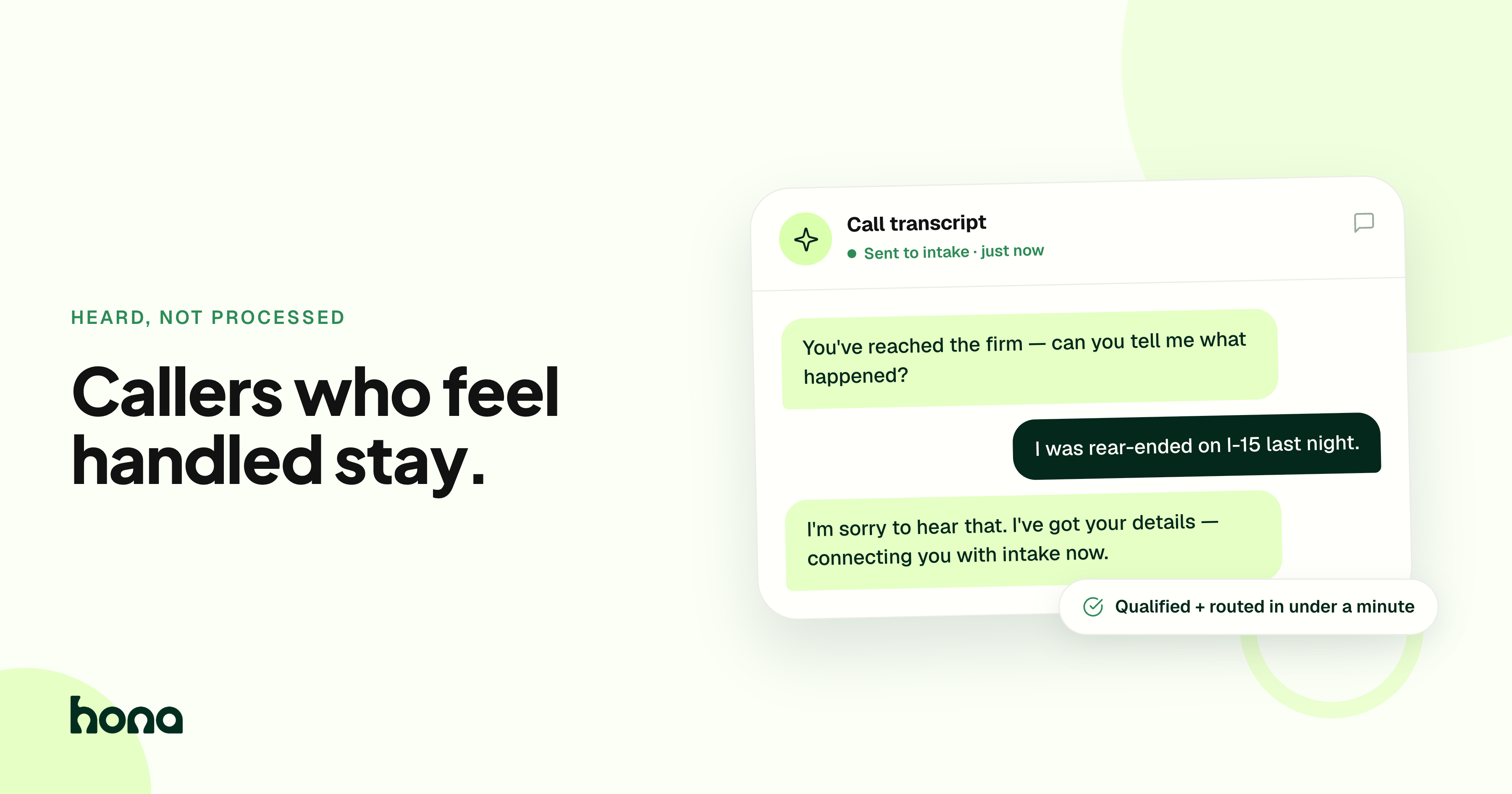
Speed and relevance win. A caller who feels handled stays. A caller who feels processed leaves.
How Hona's AI Receptionist handles the call
Hona's AI Receptionist answers every call, 24/7, and treats the first 30 seconds like they matter.
- Answers on the first ring, day or night, including after-hours and the overflow when every line is busy.
- Qualifies the caller by gathering the key intake details your team needs to size up the case.
- Routes the call based on your own call tree, so the right person picks up the ones that need a human.
- Sends an instant transcript so nothing from the conversation gets lost in a relay.
It is strongest at the work most calls actually need: answering, qualifying, after-hours and overflow coverage, and routing. For firms with simple intake, it can collect the core details on the spot. For more complex matters, it captures what counts and hands off cleanly, so a strong case never spends the night in a voicemail box.
What it sounds like to the caller
This is where firms expect AI to fall down. The worry is that callers can tell, and that it costs you the warmth a good intake depends on. WIN Disability, a disability firm, had the same worry before they tried it.
“I rolled my eyes at first. Now? My answer is an unequivocal YES.”
“She [Hona's AI receptionist] didn't sound robotic, she sounded real.”
Sam Dygert, Chief Operations Officer, WIN Disability
Pricing you can predict
Hona's AI Receptionist is priced per call, not per minute. A busy month does not turn into a surprise bill, and no one on your side is quietly rewarded for rushing a caller off the phone.
The takeaway
The caller you never spoke to is the case you never signed. See what changes when every call gets answered, qualified, and routed the same way, every time. Book a demo.
A strong case calls your firm at 7 p.m. on a Tuesday. Your office is closed. What happens in the next 30 seconds decides whether that caller becomes a client or dials the next firm on their list.
Most firms answer this with a traditional answering service. It feels like the safe choice. Someone picks up, takes a message, and passes it along. But taking a message and signing a client are not the same job, and the space between them is where good cases quietly disappear.
What a traditional answering service actually does
A legal answering service is built to take a message, not to qualify a case. That difference shows up fast.
- Generic scripts. An operator working across dozens of businesses cannot ask the follow-up questions a personal injury or disability intake really needs.
- Hold time and dead air. Callers wait, and an anxious caller does not wait long. Plenty hang up before anyone even speaks.
- Handoff friction. The message gets relayed back to your team, sometimes hours later. By then the caller has already talked to someone else.
- Per-minute meters. The longer the call runs, the bigger the bill, so the model quietly rewards short calls over thorough ones.
None of that is the operator's fault. They are doing the job the model was built for. It just is not the job of turning a caller into a signed client.
What actually converts a caller
Strip it down and a caller who signs usually got three things on that first call.
- An answer on the first ring. No voicemail, no hold music, no second-guessing whether the number even works.
- Real questions. Someone who gathers the key details of their situation, so the caller feels heard and the firm knows what it is looking at.
- A fast path to the right person. The caller gets routed where they need to go, or gets a clear next step, while the moment is still warm.
Speed and relevance win. A caller who feels handled stays. A caller who feels processed leaves.
How Hona's AI Receptionist handles the call
Hona's AI Receptionist answers every call, 24/7, and treats the first 30 seconds like they matter.
- Answers on the first ring, day or night, including after-hours and the overflow when every line is busy.
- Qualifies the caller by gathering the key intake details your team needs to size up the case.
- Routes the call based on your own call tree, so the right person picks up the ones that need a human.
- Sends an instant transcript so nothing from the conversation gets lost in a relay.
It is strongest at the work most calls actually need: answering, qualifying, after-hours and overflow coverage, and routing. For firms with simple intake, it can collect the core details on the spot. For more complex matters, it captures what counts and hands off cleanly, so a strong case never spends the night in a voicemail box.
What it sounds like to the caller
This is where firms expect AI to fall down. The worry is that callers can tell, and that it costs you the warmth a good intake depends on. WIN Disability, a disability firm, had the same worry before they tried it.
“I rolled my eyes at first. Now? My answer is an unequivocal YES.”
“She [Hona's AI receptionist] didn't sound robotic, she sounded real.”
Sam Dygert, Chief Operations Officer, WIN Disability
Pricing you can predict
Hona's AI Receptionist is priced per call, not per minute. A busy month does not turn into a surprise bill, and no one on your side is quietly rewarded for rushing a caller off the phone.
The takeaway
The caller you never spoke to is the case you never signed. See what changes when every call gets answered, qualified, and routed the same way, every time. Book a demo.